





Né en 1894, Jacques Henri Lartigue aurait pu l’utiliser, mais il n’en a rien fait. Nulle trace dans ses albums, de tirages au platine, et il ne semble pas l’évoquer non plus dans son journal où il notait scrupuleusement, durant ses premières années, ses découvertes photographiques.
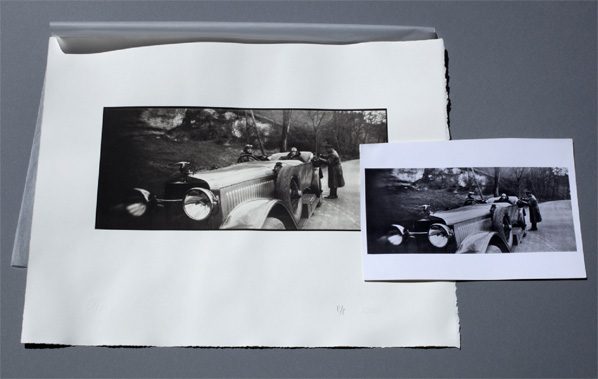
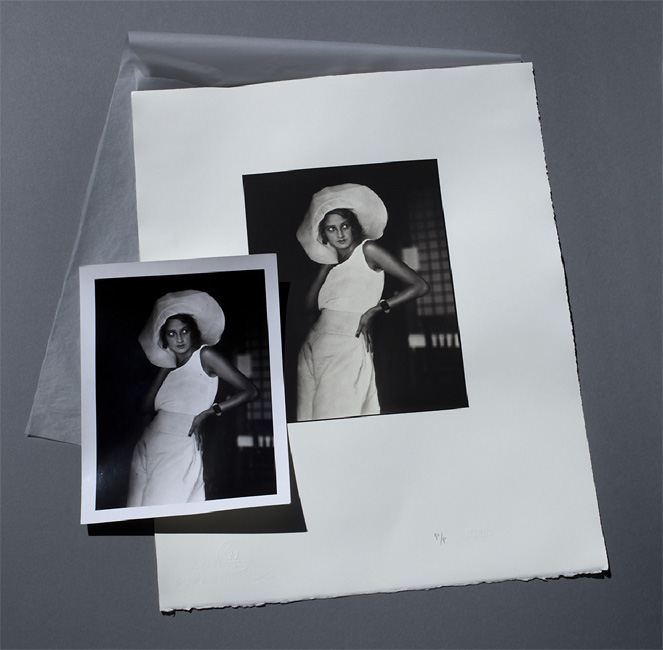
A l’instigation de Michael Hoppen, de la Michael Hoppen Gallery, qui voit dans cette technique l’opportunité de sublimer davantage les photographies, la Donation JH Lartigue décide de réaliser une édition limitée de tirages : 22 images emblématiques de l’œuvre de Lartigue tirées chacune en 35 exemplaires. Durant l’été 2003, l’exposition «The age of elegance and the art of style» à la Michael Hoppen Gallery permet de contempler ces photographies. Max Caffell de 31 Studio a réalisé les tirages dans son laboratoire en Angleterre, crée en 1988 par son père Paul Caffell.
Exposition présentée du 19 janvier au 5 juillet 2015
Lacock, near Chippenham, Wiltshire, SN15 2LG
Grande-Bretagne
Max Caffell nous fait pénétrer dans son univers de tireur au platine à travers un film court réalisé par Alasdair Ogilvie en collaboration avec le 31 Studio.
Le tirage au platine s’effectue par contact avec le négatif ou un duplicata du négatif au format voulu. Une émulsion photosensible à base de particules métalliques de platine et/ou de palladium est couchée sur le papier. Le papier est ensuite solarisé et après quelques bains chimiques, l’image est révélée.
Petite histoire du platine
En 1873, en Angleterre, le premier brevet de procédé au platine est déposé par un certain William Willis. A ce stade, ce procédé repose sur l’association photosensible des sels de fer avec les sels de platine. Progressivement, le procédé gagne en simplicité et en stabilité : en effet, les premières images obtenues ne se conservaient pas. Toujours en Angleterre, la Platinotype Company, fondée par Willis, commercialise les premiers papiers pré-sensiblisés dès 1879. Le procédé va rapidement se développer en Angleterre et très vite il gagne les Etats-Unis. Le tirage au platine présente de nombreux atouts : la richesse et la subtilité des tonalités, la grande latitude de contraste, la finesse des détails et son inaltérabilité en font un procédé très utilisé au tournant du 20e siècle. En France, le succès est plus relatif en raison notamment d’une préférence pour d’autres procédés tels que le charbon, la gomme bichromatée…
Après les années 30, le coût du platine devient si élevé que son usage se raréfie. Cependant quelques photographes continuent de l’utiliser : ainsi d’Irving Penn, de Robert Mapplethorpe, d’Edward Weston, de Bill Brandt…
D’après :
– Le vocabulaire technique de la photographie, sous la direction de Anne-Cartier-Bresson, éditions Marval
– [re]Connaître et conserver les photographies anciennes de Bertrand Lavédrine, éditions CTHS, Paris 2007